Overview
ulrichvanstryp
Feb 20
Where teams lose time
3 min read
Industrial laundry operations face constant pressure to improve accuracy, speed, and traceability while managing large volumes of linen and uniforms. Tracking thousands of items through washing, processing, packing, and delivery can be complex and prone to errors. KyberRFID and KyberInsight offer a comprehensive solution that transforms how industrial laundries manage their linen lifecycle, providing real-time visibility and control from entry to exit.
What to automate first
How KyberRFID Works in Industrial Laundry
KyberRFID is designed to track RFID-tagged linen items such as tops, bottoms, and uniforms throughout the entire laundry process. Each item carries a unique RFID tag that allows the system to identify and monitor it at every stage.
How to scope the rollout
Entry Station Scanning
At the entry point, operators start a scan using KyberRFID Readers. As items pass the reader, the system captures live data including:
What stronger delivery looks like
Item type (e.g., shirt, pants)
Weight
Section 6
Wash count
Employee ID associated with the item
Section 7
The system filters out duplicate scans within an hour to avoid errors. When scanning stops, KyberRFID generates a unique Batch ID. This batch is stored in the system, and a Batch Created email with a PDF docket is automatically sent to relevant stakeholders.
Factory Processing and Batch Lifecycle
Section 8
Once the batch is created, the items move through washing and processing stages. KyberInsight tracks the batch status through its lifecycle, keeping it visible to managers and operators. This visibility helps ensure that no items are lost or misplaced during processing.
Exit Station and Order Completion
Section 9
At packing and order completion, items are scanned again. KyberRFID looks up each tags batch, updates the location and wash count, and shows live progress, such as how many items have been scanned out of the total. When all items in a batch are scanned, the system marks the order as complete, sends a completion email with a PDF report, and removes the batch from active tracking.
If an order needs to be canceled, the system aborts the batch creation and does not generate reports, preventing confusion and errors.
Section 10
Infrastructure Behind KyberRFID and KyberInsight
The system relies on a network of KyberRFID Readers installed at entry and exit stations. These readers communicate with a central platform developed by ExpandoWorks (Pty) Ltd, which manages the database and messaging. This platform supports cloud analytics and reporting through KyberInsight.
Section 11
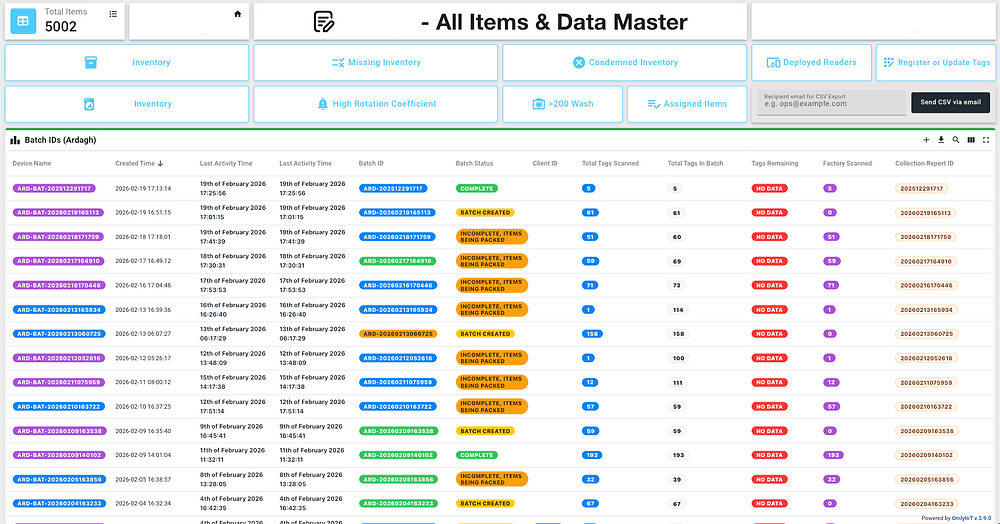
KyberInsight provides dashboards tailored for different users:
Managers can view all batches, run reports on missing items, merge or complete batches manually, and manage tags.
Section 12
Operators get live scanning feedback and batch status updates.
Clients access dashboards to view batches, book linen, track orders, and manage inventory.
Section 13
Benefits of Using KyberRFID and KyberInsight
Improved Traceability
Section 14
Every item is tracked from client dispatch through factory arrival, processing, packing, dispatch, and return. This traceability reduces losses and errors, ensuring accountability at every stage.
Real-Time Visibility
Section 15
Operators and managers see live updates on batch progress, item counts, and wash cycles. This transparency helps identify bottlenecks and improves workflow management.
Automated Reporting
Section 16
Batch creation and completion trigger automatic emails with PDF dockets and reports. This automation reduces manual paperwork and speeds up communication with clients.
Enhanced Inventory Management
Section 17
Clients can book linen in and out, track their inventory levels, and monitor linen rotation and wash frequency. This helps optimize linen usage and plan replenishment.
Alerts and Automation
Section 18
The system supports automated alerts for missing items or batch issues, enabling quick resolution before problems escalate.
Practical Example of KyberRFID in Action
Section 19
Imagine a hospital laundry facility processing thousands of uniforms daily. Each uniform has an RFID tag linked to the employee who wears it. When uniforms arrive, operators scan them at entry stations. The system creates batches and tracks each items wash count and status.
During washing, managers monitor batch progress via KyberInsight dashboards. If an item is missing or delayed, the system alerts staff immediately. After washing, uniforms are scanned again at packing stations. The system confirms all items are accounted for before dispatching them back to the hospital.
Section 20
This process reduces lost uniforms, improves turnaround times, and provides the hospital with clear reports on linen usage and condition.
Getting Started with KyberRFID and KyberInsight
Section 21
To implement KyberRFID, industrial laundries need to install KyberRFID Readers at key points such as entry and exit stations. The ExpandoWorks platform handles backend processing and cloud analytics. Training operators and managers on using KyberInsight dashboards ensures smooth adoption.
Clients benefit from access to their own dashboards, allowing them to book linen and track orders without needing direct contact with factory staff.
Section 22
Summary
KyberRFID and KyberInsight offer a complete solution for industrial laundry operations seeking to improve efficiency, accuracy, and traceability. By tracking RFID-tagged linen from entry to exit, managing batches, and providing real-time dashboards, the system supports better decision-making and reduces losses. Automated reporting and alerts further streamline operations, making KyberRFID a valuable tool for modern industrial laundries.